Ancient civilization
Ancient civilization

An ancient civilization refers to a highly organized and advanced society that existed in early human history, typically before 500 CE. These civilizations built large cities, established stable governments, and created systems that helped people live together in structured and meaningful ways. They developed writing to record laws, stories, trade, and history. Their economies were based on farming, trade, and craftsmanship, supported by technologies such as irrigation, metal tools, architecture, and transportation.
Social life in ancient civilizations was usually divided into different classes—rulers, priests, soldiers, merchants, farmers, and laborers. Religion played a major role, shaping beliefs, cultural practices, festivals, and even political decisions. Many ancient civilizations also produced achievements in arts, mathematics, astronomy, literature, and philosophy that continue to influence the world even today.
Prehistoric Era (Before 3500 BCE) :
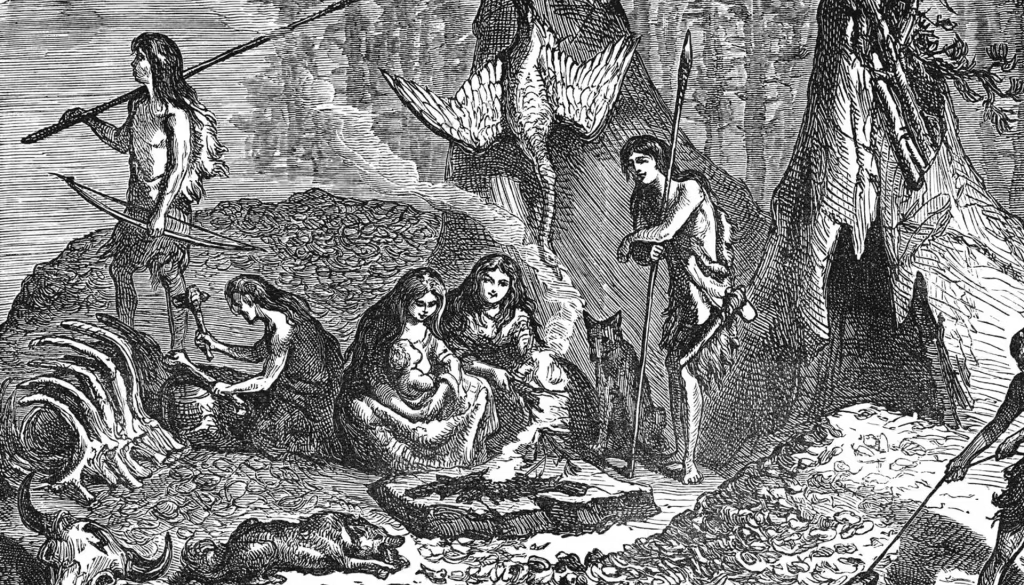
The Prehistoric Era covers millions of years, starting from the appearance of the first humans and lasting until the invention of writing systems (around 3500 BCE). During this time, humans gradually learned how to survive, adapt, and shape their environment. Archaeologists study fossils, bones, stone tools, pottery, cave paintings, fire remains, and ancient shelters to understand how people lived.
Life in this era was simple and focused on survival. Early humans hunted animals, gathered plants, and moved from place to place in search of food. Over time, they learned to make sharper tools, control fire, build shelters, create art on cave walls, and eventually farm and domesticate animals. These developments slowly led to settled communities and the beginnings of organized society.
- Paleolithic Age (Old Stone Age)
- Mesolithic Age (Middle Stone Age)
- Neolithic Age (New Stone Age)
Early Ancient Civilizations (3500–2000 BCE) :
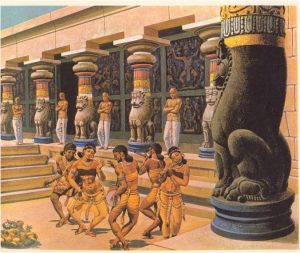
This era marks the rise of the first true civilizations, beginning around 3500 BCE. People started building large, permanent cities with planned streets, marketplaces, temples, and administrative centers. The invention of writing was a landmark achievement—it allowed them to record laws, trade transactions, religious beliefs, stories, and historical events. With writing came organized governments, which created rules, managed resources, and coordinated large projects like irrigation systems and temples.
These civilizations developed around major rivers such as the Nile, Tigris–Euphrates, Indus, and Yellow River. Rivers were essential because they provided fertile soil for farming, fresh water for daily life, and convenient routes for travel and trade. With stable food supplies from agriculture, populations increased, and societies were able to create specialized jobs such as priests, craftsmen, traders, soldiers, and rulers.
Technological advances also grew rapidly during this period, including metal tools, pottery, weaving, boats, wheels, and architectural techniques. Religion became more structured, with temples, rituals, and powerful priesthoods playing key roles.
- Mesopotamia – “Cradle of Civilization” (3500 BCE)
- Ancient Egypt (3100 BCE)
- Indus Valley Civilization (2600 BCE)
- Ancient China – Early Dynasties (Xia & Shang) (2070 BCE)
Classical Civilizations (1200 BCE – 500 CE) :
During this era, civilizations such as the Greeks, Romans, Persians, Chinese, and others made extraordinary advancements in almost every area of life. Their political systems introduced ideas like democracy, citizenship, empires, and structured legal codes that influence today’s governments and laws. Philosophers questioned human existence, ethics, logic, and the nature of the universe, laying the foundations for modern philosophy and critical thinking.
Science and mathematics also flourished. Scholars studied astronomy, medicine, geometry, engineering, and physics, producing discoveries that remain fundamental even now. Their architectural achievements — temples, amphitheaters, palaces, roads, aqueducts, and monumental sculptures — show impressive skill and creativity.
Art and literature reached new heights through poetry, drama, epic stories, paintings, and creative expressions that continue to inspire global culture. Religion and mythology shaped worldviews, moral values, and traditions that still influence societies.
- Ancient Greece (1200 BCE – 146 BCE)
- Ancient Rome (753 BCE – 476 CE)
- Persian Empire (550 BCE – 330 BCE)
- Indian Classical Empires (Maurya & Gupta) (322 BCE – 550 CE)
- Chinese Classical Dynasties (Zhou, Qin, Han) (1046 BCE – 220 CE)
Post-Classical / Medieval Era (500–1500 CE) :
After the fall of Rome, Europe saw the formation of new kingdoms, feudal systems, and the gradual strengthening of monarchies. Meanwhile, in other parts of the world, great empires and civilizations were thriving. The Byzantine Empire preserved Roman traditions, while the Islamic Caliphates became centers of learning, science, and culture. In Asia, dynasties in China, such as the Tang and Song, achieved remarkable advancements in technology, art, and commerce. Powerful states also emerged in Africa, including the Kingdom of Mali and Great Zimbabwe, and in the Americas, civilizations like the Maya, Aztecs, and Inca grew to prominence.
Trade expanded dramatically during this era. Networks like the Silk Road, the Indian Ocean trade routes, and the Trans-Saharan trade connected distant regions, allowing goods, ideas, religions, and technologies to spread. This cultural exchange introduced new foods, inventions, mathematical knowledge, and artistic styles across continents.
Religion played a major role in shaping societies. Christianity grew across Europe, Islam spread through the Middle East, Africa, and parts of Asia, and Buddhism traveled farther into East and Southeast Asia. Religious institutions influenced education, politics, architecture, and community life.
Social structures also shifted. Feudalism and manorial systems shaped everyday life in Europe, while other regions developed their own economic and social frameworks. Cities grew, craftsmanship improved, and universities began to emerge toward the end of the period.
- Byzantine Empire (Eastern Roman Empire)
- Islamic Golden Age (7th–13th centuries)
- Medieval Europe (500–1500 CE)
- African Kingdoms and Empires
- Asian Civilizations
- The Mongol Empire (1206–1368)
Early Modern Period (1500–1800 CE) :
This era marks the transition from medieval society to the beginnings of the modern world. It was a time of exploration, powerful empires, scientific discoveries, global trade, and cultural transformation.
- Age of Exploration (1500s)
- Rise of Global Trade
- Powerful Empires
- Scientific Revolution (1500–1700s)
- Renaissance & Cultural Growth (1400–1600s)
- Enlightenment (1600–1800s)
Modern Era (1800 CE – Present) :
The Modern Era marks a period of rapid change, where science, technology, politics, and society transformed the world. It begins around 1800 CE and continues up to today.
- Industrial Revolution (1800s)
- Rise of Nation-States
- World Wars (1914–1918 & 1939–1945)
- Decolonization & Independence Movements (1940s–1970s)
- Cold War (1947–1991)
- Technological Revolution (Late 1900s – Present)
- Globalization (2000s – Present)
- 21st Century Challenges & Progress
About Author:+
As a Digital marketing strategist in Kannur, I combine creative thinking with data-driven planning to help businesses grow online. With hands-on experience in areas like social media marketing, content strategy, and performance optimization, I focus on building campaigns that attract the right audience and deliver real results. Understand consumer behavior, analyze trends, and create strategies that are both practical and effective. I stay updated with the latest digital trends through continuous learning, ensuring that every project I work on brings fresh ideas and measurable impact.
Connect with me: LinkedIn
Author’s Showcase: Portfolio